
Overview
DPD (N,N-diethyl-p-phenylenediamine) is one of the most widely used reference methods for disinfectant testing and is internationally recognized (for example in the context of ISO 7393-2 for chlorine).
In practice, DPD is mainly used as a reference measurement to calibrate online amperometric sensors.
How DPD Measurement Works
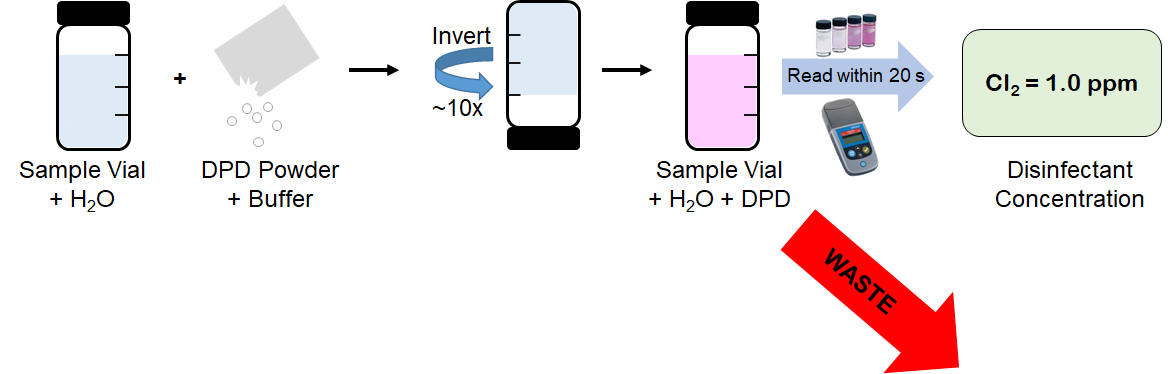
DPD reagent reacts with oxidizing disinfectants and forms a pink/magenta color. The color intensity is measured by a photometer (colorimetric method) and converted into a concentration value.
Typical workflow:
- Take a grab sample from the process water.
- Add the correct DPD reagent(s).
- Mix and wait for the specified reaction time.
- Measure with a photometer/colorimeter.
Why DPD Is Useful
- Widely available and established in field operation.
- Fast spot-check method for grab samples.
- Common baseline method for sensor calibration and verification.
Important Limitations of DPD
- Consumables and waste: Reagents are required for every test, and the treated sample cannot be returned to process.
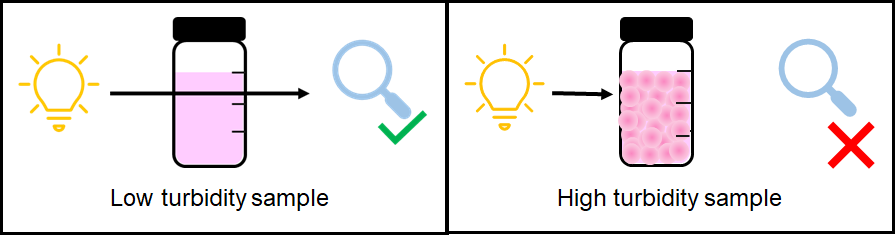
- Optical interference: Turbidity, color, particles, and sample matrix effects can bias photometric results.
- Chemical interference: DPD can react with multiple oxidants and other oxidizing species, not only the target disinfectant.
- Cross-sensitivity risk: If several oxidants are present, interpretation of the DPD result becomes more difficult.
Impact on Sensor Calibration
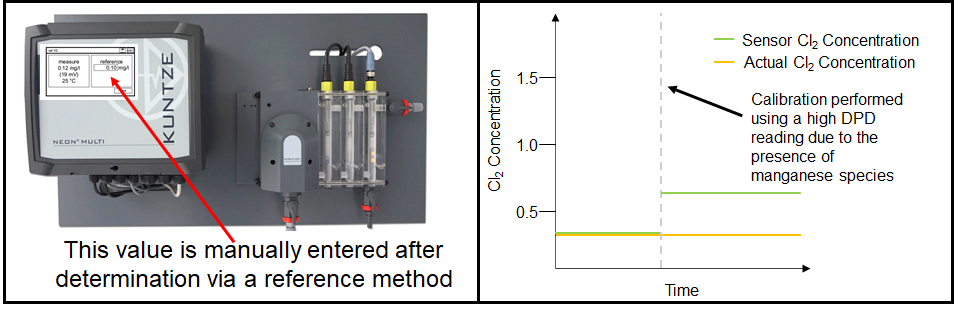
The DPD value is often used as the calibration reference for amperometric sensors. Therefore, calibration quality is directly linked to DPD quality.
- Accurate DPD reference → accurate sensor calibration.
- Biased DPD reference → biased online measurement until next valid calibration.
Best Practices for Reliable DPD Reference Values
- Use the correct DPD method/reagent set for the exact parameter (free or total chlorine, etc.).
- Follow instrument manufacturer timing and handling instructions exactly.
- Use fresh, non-expired reagents and clean cuvettes.
- Take samples close to the measuring point and avoid long delays before testing.
- If possible, run repeated measurements and use a plausibility check.
- Consider alternative or interference-compensated methods where known interferences exist.
Practical Recommendation
DPD is a strong and practical reference method when used correctly, but it is not interference-free. Always evaluate sample conditions (e.g., turbidity, color, other oxidants, iron/manganese) before using DPD values for calibration decisions.
If process-specific interferences are suspected, verify the method setup and select a more suitable reference approach where available.
Comments
0 comments
Please sign in to leave a comment.